What AI Agents Need to Work
You're in 2026 and still don't know what .md files, tools, skills, and MCP are? This might be your chance to learn about it.
AI agents aren't magic. They're kitchens. And like any kitchen, they need the right ingredients, the right equipment, recipes that work, and a standardized way to connect everything together.
Here's what that looks like in practice:
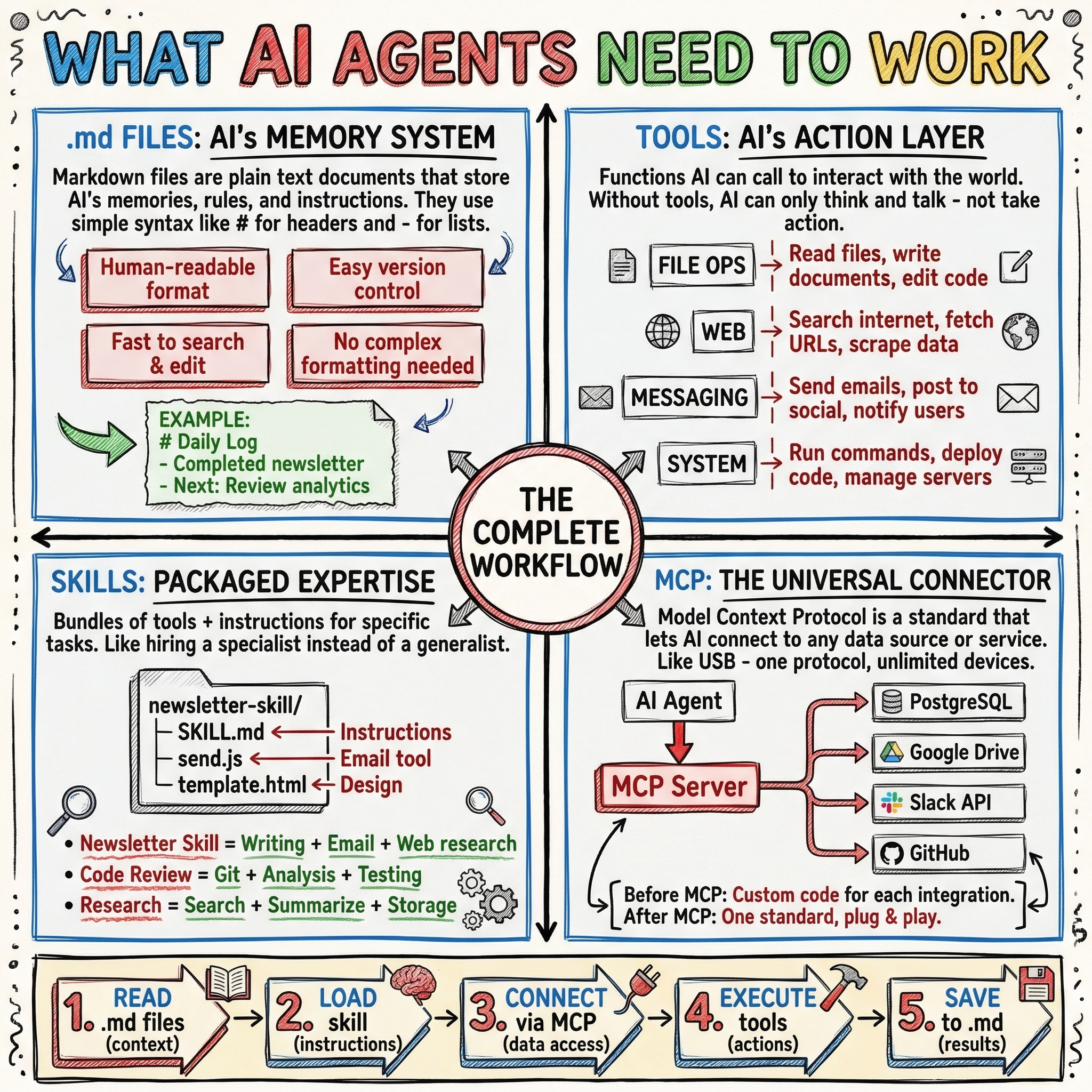
1. .md Files - The Ingredient List
Think of markdown files as your AI's recipe cards and shopping lists combined. Plain text files that both humans and machines can read, edit, and understand instantly.
Your AI needs to remember things. Not in some proprietary database that requires special tools to access, but in simple text files you can open in any editor. A file called MEMORY.md might contain your preferences. TASKS.md tracks what needs doing. PROJECT-NOTES.md holds context from your last meeting.
Example: Your AI remembers you prefer reports without charts because you store "Alex prefers data tables over visualizations" in USER.md. Next time it generates a report, it reads that file first.
Without these files, your AI starts every conversation from scratch. It's like hiring a new assistant every morning who has no idea what happened yesterday. With them, it knows your style, your projects, your deadlines, your quirks.
The beauty is in the simplicity. No databases. No APIs. Just text files in a folder. You can edit them. Search them. Version control them with Git. Your AI reads them before every interaction.
2. Tools - The Kitchen Equipment
A chef with no knife can only talk about cutting vegetables. An AI with no tools can only talk about sending emails.
Tools are functions your AI can execute. Read a file. Search the web. Query a database. Send an API request. Each tool is a capability, a way for the AI to interact with the real world instead of just simulating understanding.
Example: You tell your AI "Check if the server is responding." Without tools, it says "I can't access external systems." With a web_fetch tool, it actually pings your server and reports back the status code.
The difference between AI-assisted and AI-agented is tools. ChatGPT writes you a script. Your agent runs the script, checks the output, debugs the error, and tells you it's done.
Common tool categories:
File Operations: Read your codebase, edit documents, create new files
Web Access: Search Google, fetch URLs, scrape data from websites
Integrations: Query your database, call your API, send emails through your SMTP server
Shell Commands: Run terminal commands, deploy code, restart services
Each tool expands what your AI can do without you. That's the shift.
3. Skills - The Cookbook
You don't want your AI to have ingredients and equipment but no recipes. That's where skills come in.
A skill is a packaged workflow. It combines multiple tools with domain knowledge into a repeatable process. Like a recipe that tells you not just what ingredients you need, but in what order, at what temperature, for how long.
Example: A "GitHub PR Review" skill might combine these tools: clone repository, read changed files, run linters, check tests, post comments. All packaged as one skill you can invoke with "Review PR #247."
Without skills, you tell your AI every single step. With skills, you say "deploy the newsletter" and it knows to: pull the latest draft, convert markdown to HTML, upload to the server, update the database, schedule the send, log the action.
Skills are:
Specialized: Built for specific domains (finance automation, content workflows, infrastructure monitoring)
Reusable: Write once, use across all your agents
Composable: Combine skills together (research skill feeds into writing skill feeds into publishing skill)
The cookbook metaphor goes deeper. Just like you can share recipes with other cooks, you can share skills. Someone built a skill for scraping LinkedIn? You install it. Now your agent can do it too.
4. MCP - The Standardized Kitchen Layout
Here's where it gets interesting. You have ingredients (.md files), equipment (tools), and recipes (skills). But what if every kitchen had a different layout? Every oven worked differently? Every knife had a custom grip?
That's the problem MCP solves.
Model Context Protocol is the universal standard that lets AI agents connect to anything without custom integration every time. It's like USB-C for AI capabilities. One protocol, infinite connections.
Example: You want your AI to access your PostgreSQL database. Without MCP, you'd need custom code for that specific database, that specific AI platform, that specific authentication method. With MCP, your database exposes an MCP server. Your AI connects to it. Done.
Before MCP, every tool needed custom integration. Want your AI to read Google Calendar? Custom code. Want it to query Notion? Different custom code. Want to switch from OpenAI to Anthropic? Rewrite everything.
With MCP:
Universal: One protocol works with databases, APIs, file systems, web services, everything
Extensible: Add new capabilities without changing your agent's core code
Interoperable: Tools built for one AI platform work with others
The real power shows when you stack it. Your AI uses MCP to connect to your calendar (via Google's MCP server), your task manager (via Notion's MCP server), your codebase (via GitHub's MCP server), and your email (via Gmail's MCP server). All through one standardized interface.
You don't write integration code. You just connect.
With them? You've got an assistant that reads your files, sends your emails, manages your projects, and remembers everything.
The shift from "AI-assisted" to "AI-agented" is happening now. Finance teams, consultants, developers. Everyone's building their own agent teams.
Sources
- doormen.io - AI agent platform documentation